

Is My Pool Leaking? Why Ignoring Water Loss Is Draining Your Wallet (and Ruining Your Backyard or Equipment)

The Carolina summer heat is officially here, and across Charlotte, Harrisburg, and Concord, backyards are in full swing. But if you’ve noticed your pool’s water level dropping, you might be sitting on a ticking financial time bomb.
It’s easy to blame the humid North Carolina air and assume it's just natural evaporation. Many homeowners try to manage a suspected leak by simply leaving the garden hose running to top it off.
Unfortunately, hiding a leak with a garden hose doesn't just mask the problem it actively drains your bank account and threatens the structural integrity of your entire backyard investment.
Here is why ignoring water loss is costing you more than you think, how a quick DIY bucket test can confirm your fears, and why you need a professional leak detection specialist to step in immediately before a minor issue becomes a total backyard rebuild.
The Hidden Cost of "Just Topping It Off"
When your pool is constantly losing water, you aren't just paying a higher monthly water bill. You are actively flushing money down an underground drain in two major ways:
The Chemical Drain: Every gallon of fresh water you add from the hose has a neutral pH and zero chemical sanitizer. As your treated, perfectly balanced pool water leaks out, it takes your expensive shock, chlorine, stabilizers, and salt with it. You end up trapped in an endless, expensive cycle of throwing money into chemicals just to keep the pool from turning green.
The Structural Erosion: Water escaping an inground pool doesn't just vanish into thin air. It collects behind pool walls, settles under concrete decks, and saturates the surrounding Carolina clay. Over time, this constant underground flow washes away supporting soil, leading to sinkholes, shifting foundations, and collapsed pool walls.
Confirming the Leak: The 24-Hour Bucket Test
Before calling an expert, you can use a quick, zero-cost method to confirm if you are dealing with normal evaporation or a structural leak.
Set up the bucket
Step 1
Place a standard 5-gallon plastic bucket on the top step of your pool stairs. Fill it with pool water until the water level inside the bucket perfectly matches the pool's water level on the outside.
Mark the lines
Step 2
Turn off the pool pump. Use painter's tape or a marker to mark the exact water level inside the bucket and the pool water level on the outside of the bucket.
Wait and compare
Step 3
Turn your pump back on and run it normally for 24 hours. If, after one day, the pool water level has dropped lower than the water inside the bucket, you have an active leak.
Once that bucket test shows an uneven drop, the DIY phase is officially over. Finding where that water is escaping requires specialized equipment and deep structural knowledge, because every pool type fails in completely different ways.
What a Leak Means for Your Specific Pool Type
The path of destruction a leak takes depends entirely on how your pool was constructed.
1. Vinyl Liner Pools: Is Your Liner Past Its Expiration Date?
If you have a vinyl liner pool in the Concord or Harrisburg area, water escaping through a tiny puncture or split doesn't just drop into the ground, it gets trapped behind the vinyl.
The Risk: This causes the liner to "float" away from the walls, stretching it out of shape and creating permanent, ugly wrinkles.
The Structural Impact: The water will rapidly wash away the vermiculite, sand, or grout floor beneath the liner, creating deep divots, soft footprints, and structural shifting.
The Solution: If your vinyl liner is over 7 to 10 years old, it becomes brittle and highly susceptible to dry-rotting at the water line and splitting. A leak in an aging liner is often the ultimate sign that it’s time to stop patching and schedule a professional liner replacement.
2. Gunite & Concrete Pools: Is It Time to Resurface?
Concrete pools are incredibly durable, but they are rigid. As the ground shifts or settles over the decades, concrete can experience hairline structural cracking.
The Risk: Water can seep through structural cracks or migrate behind the plaster coat, causing the interior finish to delaminate, bubble, and pop off.
The Solution: A consistently leaking gunite pool is often a cry for help indicating that the shell needs to be professionally prepped, repaired, and completely resurfaced to restore its watertight seal.
3. Fiberglass Pools: Shell Cracks vs. Plumbing Shifts
Fiberglass pools are non-porous and flexible, but they are entirely dependent on the sand or gravel backfill that surrounds them.
The Risk: If water leaks out from a plumbing line or a structural crack, the shifting ground water pressure can cause the fiberglass walls to bulge inward or settle unevenly.
The Solution: An expert must determine if the water loss is coming from a rare gel-coat structural crack or if the pool shell is completely sound and the issue lies in the plumbing connections.
Beyond the Shell: Hidden Leak Hotspots
If the pool shell itself isn't leaking, the culprit is almost always hidden deep within your equipment pad, behind the walls, or buried under your concrete decking. Professional leak detection looks beyond the visible interior finish to comprehensively test and isolate these highly vulnerable areas:
1. Underground Suction and Return Plumbing Lines
The PVC pipes running underground are under constant environmental stress.
The Risk: The lines running from your skimmers and main drains as well as the pressurized return lines that push clean water back into the pool can crack, fracture, or completely separate at the glued fittings. This is usually caused by heavy ground settling, soil expansion, or tree root intrusion. Because these pipes are buried deep beneath your lawn or concrete deck, a pressurized return line leak can wash away the underlying dirt, causing sections of your pool deck to suddenly drop or crack.
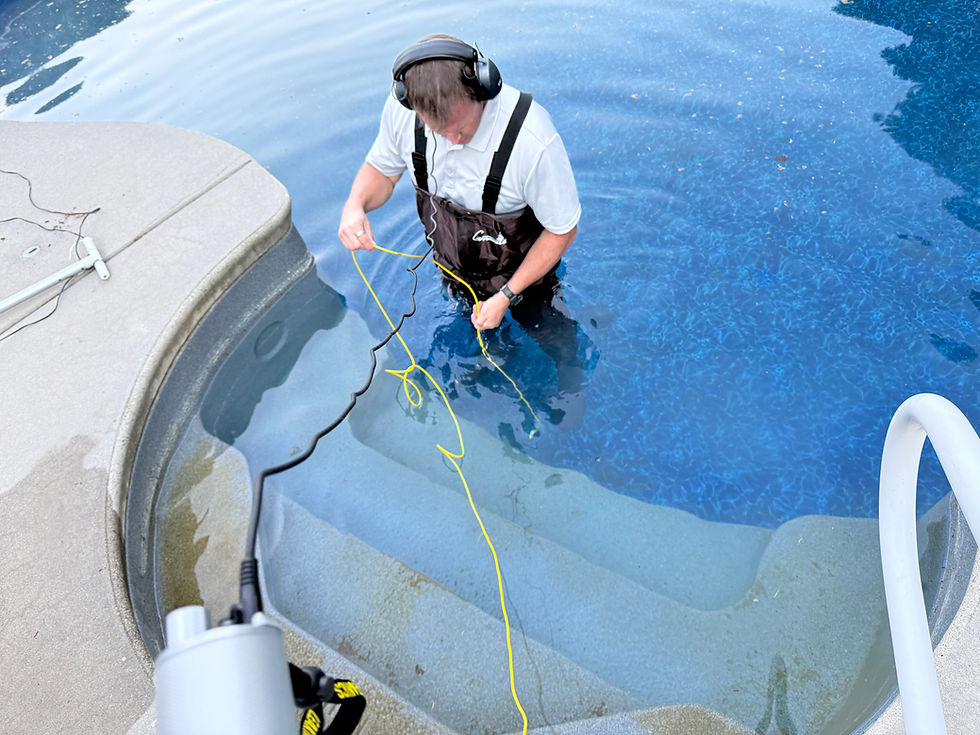
The Solution: An expert will perform a computerized plumbing pressure test. By isolating each line and filling it with a mix of water and pressurized air, we can listen for the exact underground "hiss" using specialized acoustic microphones. This allows us to cut open and repair just the single square foot of soil or concrete where the break exists, rather than digging up your whole yard.
2. Fixtures, Fittings, and Main Drains
Leaks frequently hide in plain sight right where plastic, vinyl, or metal components meet the pool shell structure.
The Risk: The rubber gaskets, silicone seals, and compression rings around underwater pool lights, skimmer throats, main drains, and the threaded fittings of your wall return jets dry out, dry-rot, and crack over time. This creates a tiny gap that allows water to constantly seep out of the pool and migrate behind the shell or liner.
The Solution: We utilize precise underwater dye-testing. By injecting a heavy, specialized colored dye right next to these fittings with the pump turned off, we can visually watch if the dye gets sucked out through a failing gasket or cracked light niche, confirming the exact point of entry.
3. Dedicated Spa Jets and Booster Lines
If you have an attached or raised spa, your backyard has a much more complex web of hidden engineering.
The Risk: The high-pressure lines feeding your spa jets and air induction lines are buried deep behind the spa walls. Because spas experience high heat, chemical concentrations, and intense structural vibration from powerful booster pumps, these jet bodies and plumbing manifolds are highly prone to developing hidden stress fractures that cause rapid water loss when the spa is running.
The Solution: Specialized inflatable pipe plugs are used to isolate the spa's plumbing loop from the main pool. We can pressure-test the spa system independently to confirm if the leak is localized to the jet manifold or a specific booster line, ensuring we don't misdiagnose a pool issue for a spa issue.
4. Luxury Water Features and Spillovers
Custom rock waterfalls, elevated spas with geometric spillovers, sheer descents, infinity edges, deck jets, and laminars add incredible luxury, but they introduce a massive amount of plumbing vulnerability.
The Risk: The internal plumbing manifolds feeding these features, combined with the mortar joints and waterproofing membranes beneath stone or tile work, are highly sensitive to seasonal weather cycles and minor ground shifting. A hairline crack in a stone spillover or a split inside a sheer descent manifold can leak thousands of gallons unnoticed as water runs back behind the rockwork instead of into the pool.
The Solution: We run targeted isolation tests on each individual water feature. By turning off the main pool circulation and running only the feature, we can measure the accelerated rate of water loss and inspect the structural mortar joints with electronic leak-locating tracks to find exactly where the waterproofing membrane has failed.
Stop Pouring Money Down the Drain: Call a Local Expert
Trying to find a subterranean pipe leak or a pinhole liner tear on your own is like looking for a needle in a haystack. Homeowners who try to guess usually end up tearing up the wrong sections of their concrete decking or digging massive, muddy holes in their lawns, costing thousands in unnecessary property damage.
Professional leak detection doesn't guess we use specialized digital equipment, acoustic listening devices, plumbing line pressure tests, and targeted dye testing to pinpoint the exact square inch of the problem without damaging your property.
Get Your Backyard Back: Don't let a hidden leak steal your summer peace of mind, destroy your chemical balance, or ruin your pool structural foundation. At Sunkissed Pools and Spas, we provide transparent, concierge-level leak detection and structural restoration services across the greater Charlotte area.
Ready to stop the water loss? Let's chat. Email us at sunkissedpoolsandspas@gmail.com, Visit our website to connect www.sunkissedpoolsandspas.com Call or Text us at our work number 980-447-6004 or direct 910-583-3817


Comments